Web searching should be as simple as providing the search engine with
a query and having the search engine return a link to the desired Web
page. Unfortunately, current Web search engines use text based queries
and therefore require the user to provide keywords. Converting the
users information need into a few key words is not a simple
process. Due to this, Web search patterns involve the user visiting
many Web pages that do not satisfy their information need, while
interleaving this process with several visits to the Web search
engine. Rather than the user actively searching for pages using key
words, the search engine could provide pages to the user based on
their Web usage patterns. By examining the users Web history, we will
be able to compute the types of Web pages the user desires and hence
provide search results to the user without the need for key
words. This method of passive Web searching is called
prefetching. Given that Google has had such success in using link
analysis to provide useful retrieval results, we aim to investigate
the utility of Web links to perform prefetching.
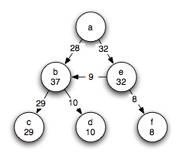
To date, we have successfully applied eigenvalue analysis to our
temporal link graph (shown in Fig. 3) to obtain a measure of
importance for each page. We will be examining the effect of using
Hidden Markov models and their benefit over the eigenvalue analysis.
A temporal link graph showing the time spent on each page (shown in each circle) and the portion of time from users that have followed each of the incoming links (shown on each of the directed edges).